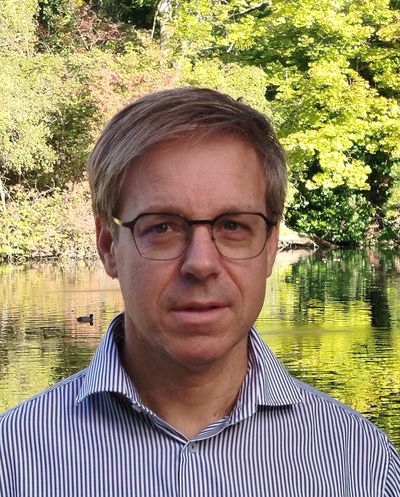
Ir, PhD, HDR
Associate Professor in Computational Neuroscience
Université Bourgogne Europe · INSERM U1093 CAPS, Dijon
How the brain controls movement when the world changes
I study how the brain plans, controls and adapts movement, and how it copes when the environment changes. Trained as a computer-science engineer before a PhD in computational neuroscience, I combine human experiments with mathematical models of control, noise and variability.
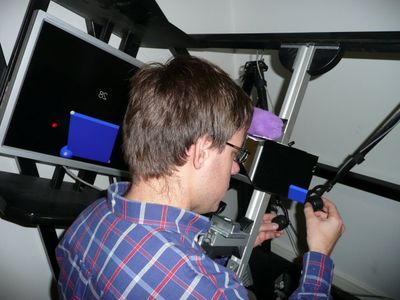
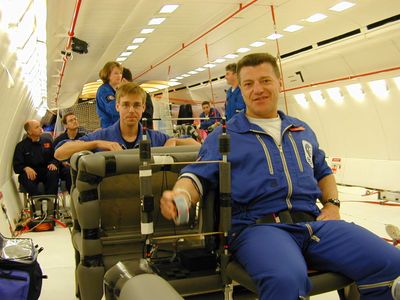
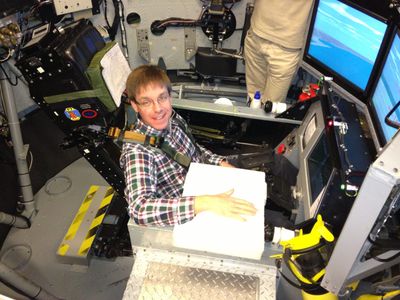
My experiments take place in the lab, in immersive virtual reality and on haptic robots, but also in parabolic flights, human centrifuges and bedrest facilities. Changing gravity, or perturbing the senses, reveals what the nervous system normally predicts and compensates without our noticing.
Research themes
News
- 2026Paper with V. Gritsenko, J. Babič and colleagues published in PNAS: parabolic flight dissociates gravity from limb dynamics in the control of arm movements.
- 2026Talk at the COSPAR Scientific Assembly, Florence.
- 2026Appointed Section Editor-in-Chief, “Behavioural Biology”, Biology (MDPI).
- 2026Review on gravity, microgravity and artificial gravity published in Physiological Reviews.
- 2026Single-author paper on auditory–visual crosstalk in motor learning, European Journal of Neuroscience.
- 2026Paper with D. Barbusse on adapting to an upside-down posture, Journal of Neurophysiology.
- 2026Press: Daily Science (Belgium) on fundamental physics and the control of gestures.
- 2025Co-PI of the 69th CNES parabolic-flight campaign (September).
- 2025ANR MRSEI awarded to build the SYNOISE consortium on functional variability.
- 2025Denis Barbusse defended his PhD (13 January) and joined the Albert Einstein College of Medicine, New York, as a postdoc.
Beyond the lab. Before all this, I cycled 6,000 km across the United States, from Washington DC to San Francisco, and co-wrote a book about it, L'Amérique à 12 vitesses.